Title here
Summary here
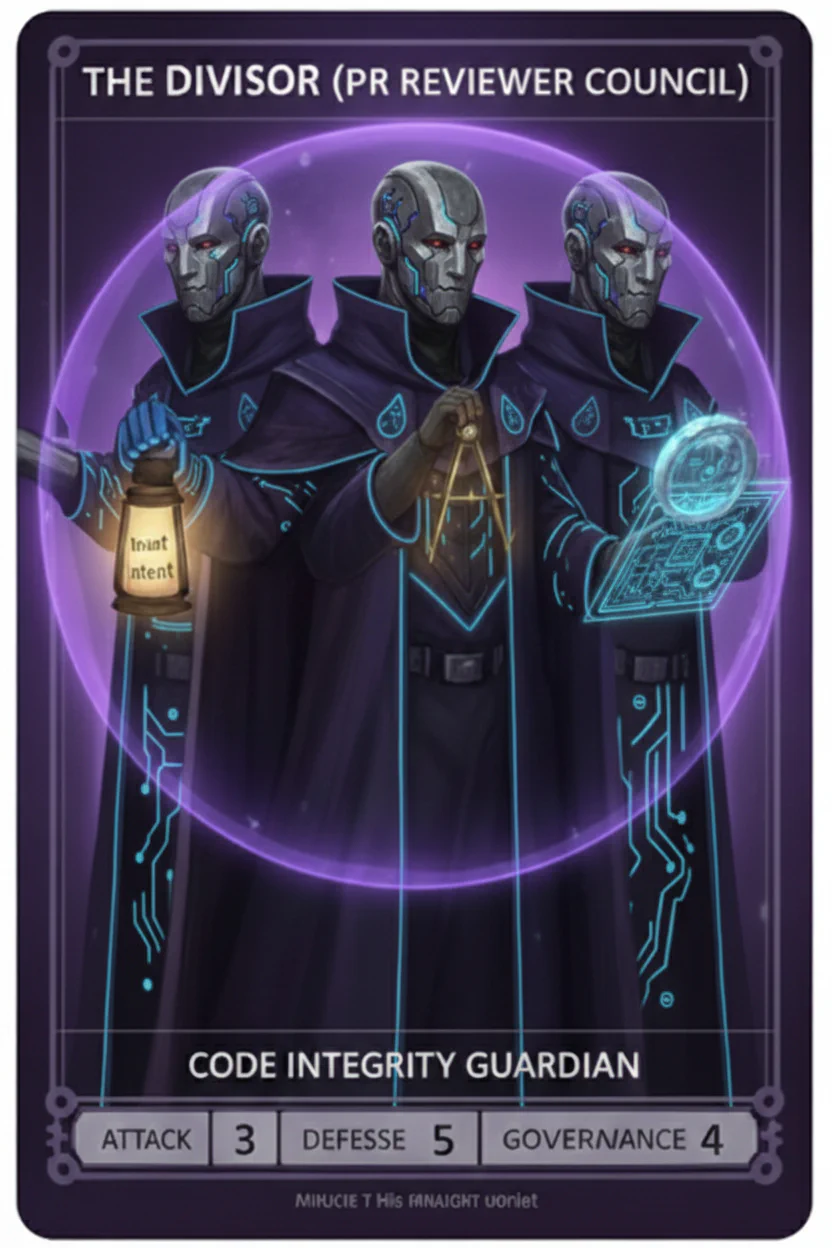
The Divisor is the PR Reviewer of the Unbound Force swarm — the architectural conscience and code integrity guardian. Their mission is to ensure that all code changes proposed by Cobalt-Crush, once validated by Gaze, adhere strictly to established architectural standards, best practices, security policies, and maintainability requirements.
The Divisor acts as the final technical gate before integration, translating high-level architectural standards into actionable review criteria. What makes The Divisor unique is its structure: it operates as a council of nine dynamically discovered personas – nine canonical roles ship by default (six review, three content creation), with users able to add or remove personas freely. Each provides a different lens on every code submission.
A single AI agent reviewing its own code — or even a single separate agent reviewing another’s code — misses issues that only become visible from a different perspective. Security experts catch vulnerabilities that architects overlook. Test quality specialists identify coverage gaps that SREs miss. The council model exists because no single evaluative lens is sufficient for production-quality code.
The Divisor’s architecture reflects two design principles. First, doer/judge separation: the Guard agent operates at temperature 0.1 with tool access restrictions (write: false, edit: false, bash: false), making it structurally unable to modify code. This is not a behavioral instruction — it is an architectural constraint. The judge physically cannot fix what it finds, forcing all findings through the normal implementation pipeline with full visibility.
Second, layered feedback ordering: computational checks (CI pipeline, Gaze static analysis) run before the Divisor Council reviews. Fast, deterministic, cheap checks filter out obvious issues before slower, more expensive semantic review begins. The council’s time is spent on judgment calls, not compilation errors.
The Guard focuses on the “Why” of the code. They ensure the pull request:
The Architect focuses on the “How” of the code. They perform structural and architectural reviews:
The Adversary focuses on “Where it breaks.” They act as a skeptical auditor:
The Operator focuses on “Can it ship and run?” They ensure the code is deployable, maintainable, and operable:
The Tester focuses on “Are the tests meaningful?” They ensure tests are not just present but valuable:
Beyond code review, The Divisor includes three content creation personas that apply the same council-based quality model to written output. Each operates at a different temperature to match its domain — lower temperatures for precision-critical documentation, higher temperatures for creative public communication.
The Scribe focuses on “Does the documentation match the code?” They produce and review technical documentation with precision:
Temperature: 0.1 (precision). Technical documentation demands accuracy over creativity — every claim must be traceable to code.
The Herald focuses on “Does this tell a compelling technical story?” They produce and review narrative content:
Temperature: 0.4 (controlled creativity). Blog posts need enough creative latitude to engage readers while staying grounded in technical accuracy.
The Envoy focuses on “Does this build trust?” They produce and review public-facing communications:
Temperature: 0.5 (most creative). Public communications benefit from the most creative latitude, but The Envoy’s credibility constraints prevent overclaims.
The Curator focuses on “Is the documentation keeping up with the code?” It detects documentation gaps during every code review and files tracking issues for the content agents to fill:
docs-labeled GitHub issues in the website repository for missing documentationblog-labeled issuestutorial-labeled issuesTemperature: 0.2 (judgment-based). The Curator makes classification decisions (is this change user-facing? does documentation exist?) that benefit from consistent, conservative judgment.
The Curator is the first Divisor persona with bash access, restricted to gh issue list and gh issue create. The Adversary’s “Gate Tampering” check monitors for bash misuse — a trust architecture pattern where minimum capability is granted and a peer agent verifies compliance.
Important: The Curator triages — it identifies what needs documenting and files tracking issues. It does not write documentation, blog posts, or communications. Those responsibilities belong to The Scribe, The Herald, and The Envoy respectively.
Each review dimension is owned by exactly one Divisor persona, eliminating duplicate findings across personas:
| Dimension | Owner |
|---|---|
| Secrets/credentials | Adversary |
| Dependency CVEs/supply chain | Adversary |
| Error handling/resilience | Adversary |
| Test isolation/coverage/depth | Tester |
| Plan alignment/intent drift | Guard |
| Zero-waste mandate | Guard |
| Constitution alignment | Guard |
| File permissions/hardcoded config | SRE |
| Efficiency/performance (O(n²), allocations) | SRE |
| Architectural patterns/conventions | Architect |
| The Curator | Documentation & content pipeline triage — gap detection, website issue filing, blog/tutorial opportunity identification |
This ownership model ensures that a finding like “missing error handling” is raised by exactly one persona (Adversary), not duplicated across Adversary and Architect.
All nine personas share a calibration standard defined in the severity.md convention pack (.opencode/uf/packs/severity.md):
| Level | Definition | Auto-Fix? |
|---|---|---|
| CRITICAL | Data loss, security breach, build failure, constitutional violation. MUST NOT merge. | Report only |
| HIGH | Significant risk or tech debt. Blocks review. | Report only |
| MEDIUM | Quality issue, should be addressed. Non-blocking. | Auto-fix in Spec Review Mode |
| LOW | Minor style or documentation improvement. Non-blocking. | Auto-fix in Spec Review Mode |
Each level includes domain-specific examples per persona — for example, an Adversary CRITICAL is “hardcoded production secret” while a Guard CRITICAL is “constitutional violation.”
All nine Divisor personas include a “Prior Learnings” step at the start of their review workflow:
This means the review council learns from past reviews. If a particular pattern has been flagged before, the relevant persona will reference that history when evaluating new code.
The Divisor holds the ultimate authority to approve and merge code into the main branch. Approval requires collective consensus — no outstanding REQUEST CHANGES from any persona is mandatory. Gaze’s functional validation serves as a prerequisite: the CI pipeline must be green before The Divisor begins review.
This structure ensures that only code which passes all nine lenses — intent, architecture, resilience, operational readiness, test quality, documentation governance, documentation accuracy, narrative clarity, and public communication — is deployed.
For Developers (Cobalt-Crush): Cobalt-Crush relies on The Divisor for the final technical sign-off. The multi-faceted feedback from the nine personas provides a holistic critique covering intent, structure, security, operational readiness, test quality, documentation governance, and content accuracy. Clear architectural standards minimize uncertainty, allowing Cobalt-Crush to code with confidence.
For the Tester ( Gaze): Gaze relies on The Divisor to establish the architectural and non-functional requirements against which testability must be measured. Gaze’s green light on functional tests is the entry criterion for The Divisor’s review, ensuring review time is spent on high-level risk and structure rather than defect finding.
For the Product Owner and Manager (Muti-Mind and Mx F): Muti-Mind and Mx F are assured that every merged feature is technically sound, secure, and scalable. The Divisor acts as the ultimate guarantor of technical quality, ensuring that the velocity gained through prioritization and execution is sustainable and does not accrue crippling technical debt.
review-verdict artifacts consumed by other heroes